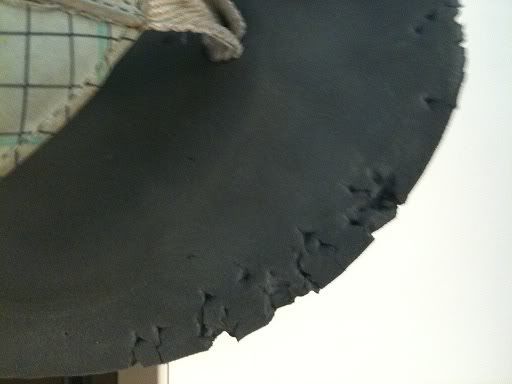
So, I had a different post planned (featuring various photos like this of things my cat has destroyed. Yes, he ate my flip-flop. And attacked my brand-new MacBook Pro. Funny story!). But luckily for you all, now you don't have to listen to more cat stories. Yet. Instead you get a new rant! Yay! Don't you love rants?!
I should preface this by saying: I did not major in Creative Writing (though not for lack of trying). Or English (because those discussions made me want to defenestrate books I otherwise loved).* I studied Linguistics.
For those of you who don't really know what that is (because I didn't until I signed up to major in it. I plan ahead so well!): Linguistics is the study of human language.
Not relatively-recently-constructed grammatical speech rules. Human language. How it's actually used, and how we actually speak.**
One of the things I loved about linguistics was studying dialects. English has hundreds of dialects. Some of them are so different from ours that it's hard to believe they're the same language (try wandering around the streets of Glasgow if you want an example. Or listen for some Pennsylvania Dutch next time you're in Amish country). As my professors so often loved to quote, the only difference between dialects and whole new languages is that "a language is a dialect with an army and a navy."
Back in the day, when we all lived in relative seclusion from people just a few townships over, accents could vary dramatically within a small area. Northern England is still a fantastic example of this. I was standing in a taxi queue in Newcastle one time, listening to a discussion that went something like "You first, mate." "Oh, Barmston aye?" "Weyhey. Whitley Bay?" <-- those towns are about a 30 minute drive apart. In those few words, the speakers could both tell where the other was from.***
However, since the advent of T.V., something has shifted. In the U.S., the Standard Midwestern accent (that spoken by our newscasters and most actors) has become the accent to speak. It's considered the educated speech pattern for most USians.**** If you speak with a Brooklyn accent, for example, your teachers will probably train it out of you. Teach you to speak "normally" (or worse, "without an accent"*****).
That's fine for job interviews and all. I get it. People have a bias against anyone who speaks with a dialect. But I just need to say:
ACCENT/DIALECT =/= INTELLIGENCE.
HOW someone speaks in NO WAY indicates his/her brain's cognitive abilities. If someone speaks like a hillbilly, they might lack a formal education, or they might resist conforming to normal linguistic biases, but THEY ARE NOT NECESSARILY STUPID. Others might PERCEIVE them as a bit thick, yes.
But if, for example, you're writing a story with characters who have thick accents... You do not have to make them dumb. Nor do you have to tone down their accents to make them sound smart (though you might not want to spell out every word in a thick brogue, because that would get hard to read). They can be intelligent and use the word "ain't."
Because you know what? Ain't is a word. We all know what it means. Just because it "isn't proper" does not mean that's not how people speak in everyday life.
Writing dialogue is not about following English grammar rules to the letter.****** It's about figuring out, linguistically, how people really talk. And trying to get your writing as close to that as possible.
Characters with accents can be hard to write. You need to balance their weird expressions with "normal" English just enough so that the reader hears the accent without stumbling over the sentence structure. It takes practice. It takes a good ear, especially if the accent you're writing isn't your native one.
But if you can do it well, go for it. At first glance it will probably make people stereotype your character. But then you get to subvert said stereotype for the rest of the story. Show people why their prejudice against weird dialogues/accents is erroneous. Because isn't that the best part about writing? Showing people that something different ain't always bad?
... And if this rant did not make very much sense, I blame the Starbucks. I'm not used to caffeinating this early.
* Please don't kill me if you're an English major! Not saying English is a bad major. In fact, it was way too hard for me, which is why I avoided it. All that analyzing wasn't my cup of tea.
** By the way, young writers, if you also hate English classes but love writing, linguistics classes are a fantastic way to learn how to write realistic dialogue.
*** All sounded just as bloody indecipherable to me, but that is because I have untrained foreigner ears!
**** Not saying they didn't have a bias toward certain accents back in the day, just that it was a less wide-spread bias. Unless you were super-rich, it probably didn't matter how you spoke.
***** This is a whole other rant for another day, but let me just say: NOBODY HAS "NO" ACCENT. If you speak out loud, then you have an accent. If you think you don't, chances are your accent is Standard Midwestern American. Just saying. /end pet peeve rant.
****** Well, okay, rules like punctuation and spelling are good to follow to the letter. I meant like "don't say ain't" and "don't use 'them' as a gender-neutral singular pronoun for 'someone' because it's improper" kind of rules.
lol. nice. i'd forgotten you did linguistics. but understand now, completely, how when i first joined crit group and told one member that she was a little heavy handed on the dialogue slang and you were like "I THINK IT's FINE" where that was coming from. love this post :)
ReplyDeleteI will admit that do have a personal vendetta against people who don't write with at least semi-proper punctuation...or, at the very least, consistent punctuation. It's there for a reason: to aid comprehension.
ReplyDeleteIt will be interesting, however, to see how technology and IM-speak alters the "traditional" sort of language that is used and accepted in academia and business. We probably won't be around long enough to witness any lasting changes, but you never know. For instance, I would bet that our parents never dreamed of starting emails with "Hey" or "Hi" or just a first name rather than a formal salutation.
@Corrie - LOL yes totally. ahem. but I may be biased in that direction ;)
ReplyDelete@Allison - oh yeah, I am such a stickler about punctuation... have you read Eats, Shoots and Leaves? best punctuation rant in book form ever, mwahaha.
And yeah, I think we already see that a bit... I mean, I get work emails with smiley faces :)
This post makes me think of my elementary school gym teacher- his PA Dutch accent was so thick he was more or less shouting at us in German! PA Dutch amuses me greatly as the sentence structure is mostly German and there are random Native American-ish words. My dad has actually had to have interpreters for some of his patients because of the language barrier (in Amish country). Honestly, I don't know if PA Dutch counts as an English dialect or a German one. I think it's somewhere between, with different shades.
ReplyDeleteGood points! But here in the NYC area, all the newscasters speak with a cultured East-Coast accent. :)
ReplyDelete@runebuddha Lol! I love that you sometimes need interpreters, but it makes sense.
I wonder about all the Yiddishisms and Hebrewisms we use within the Jewish community. Typical synagogue talk: "Gut Shabbos. And yasher koach on Musaf, man. You should daven more often. Maybe we'll get out on time for a change."
Is that its own dialect? Or is it just comparable to the normal sub-dialects that form in any community, like the workplace? Phone company people, when talking about the job, can only be understood by other phone company people, after all . . .
@Liz -- haha, true, but that's why I love PA Dutch! it's sooo weird :D I <3 the weird ones... also, I like how some of it carries over -- like on all the Pittsburghese sites, they call "redd up" (to get ready) Pittsburghese, but I think it comes from PA Dutch originally?
ReplyDelete@J. Rosemary -- hmm, sounds kind of like Spanglish to me (which I guess is less a dialect and more a speech pattern among people who speak both languages?). really interesting though!
and, cultured East-Coast is usually the same thing as standard midwestern (cause by that I don't mean the local speech in the midwest, I mean standard American accent? that's just where it supposedly originated...). But I dunno, I live in NYC area, don't watch the news much though :) maybe I'll have to, hehe
Hey, new follower here. Also, mmm, linguistics. I considered majoring in it once upon a time.
ReplyDeleteMy two protagonists are backwoods Arkansas hillbillies, without a doubt. They're uneducated and ignorant and their speech reflects that. They aren't stupid, but some people think they are because of the way they speak. I think it's a fine balance for me, because one of the protagonists is not what you might call conventionally "smart." The best way I know to handle it is to show them being competent people. They might use coarse language and not know big words or worldly concepts, but I still try to make them engaging for the reader.
Really, the hardest part about writing them is that I have to tone down my vocabulary and consider whether they'd even know the words I'm using.